What Makes a Princess Cut Diamond Different?
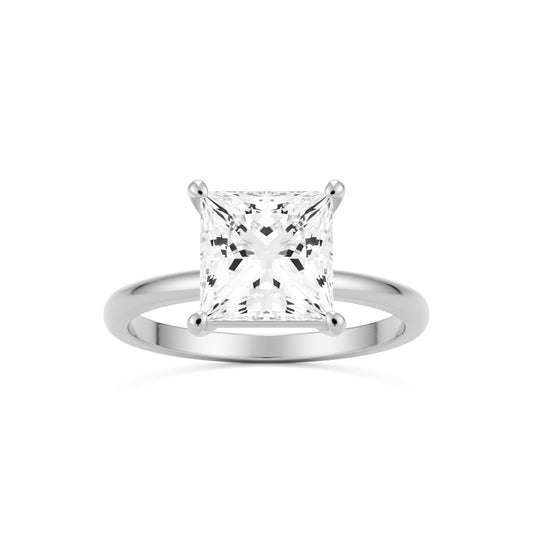
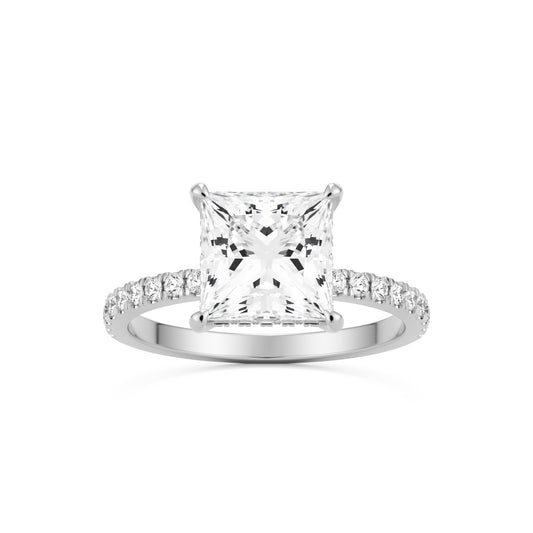
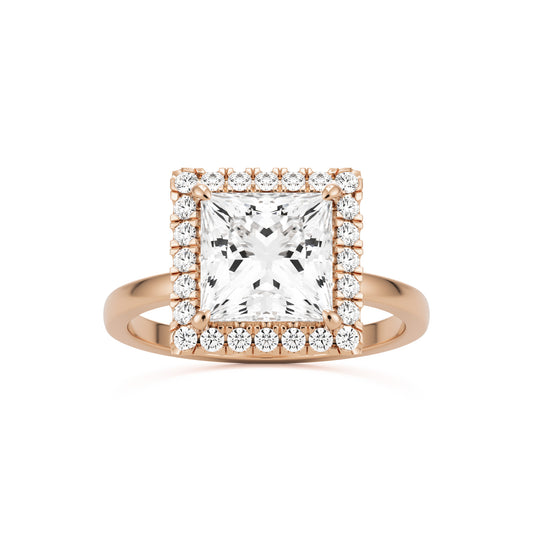
The princess cut is typically square when viewed from above, with four straight sides and pointed corners. Beneath the surface, its brilliant-style facet arrangement creates a very different light pattern from square or rectangular step cuts.
This combination gives the princess cut its defining character: square geometry with brilliant-style sparkle.
Princess diamonds can also display different facet patterns depending on how they are cut. When viewed from above, these variations can affect whether the diamond shows larger, more distinct flashes or a more intricate pattern of smaller reflections.
Princess Cut Lab Diamond Ring Styles
The straight edges and sharp corners of a princess diamond work particularly well with settings that complement its geometric outline.
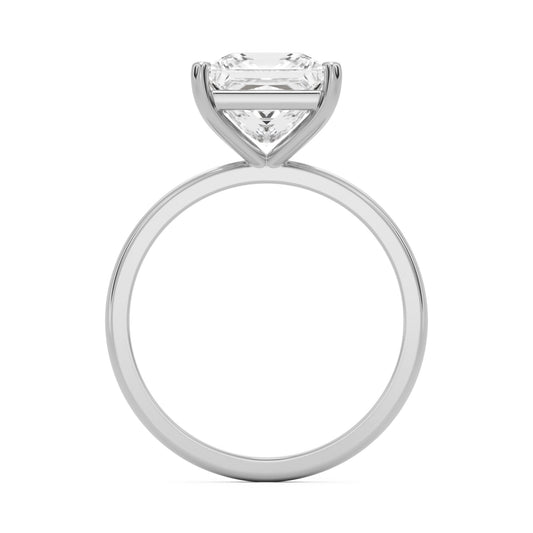
Solitaire settings emphasize the symmetry and square shape of the center diamond.
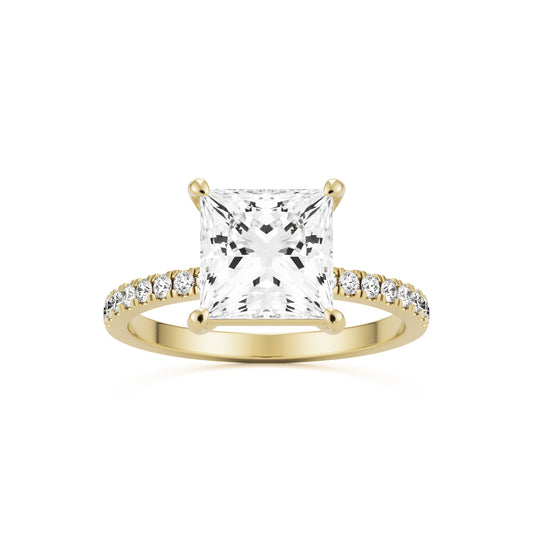
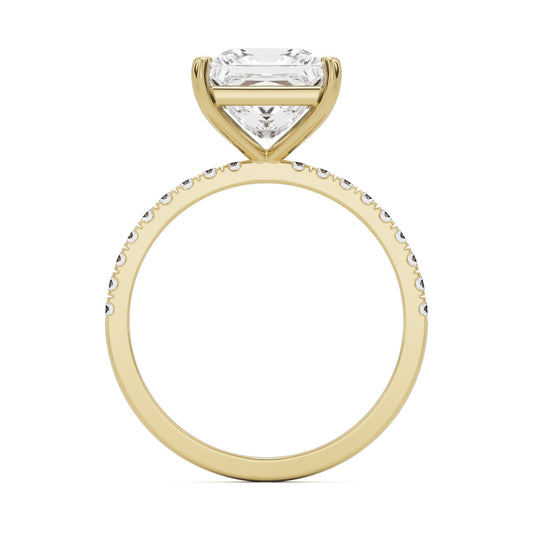
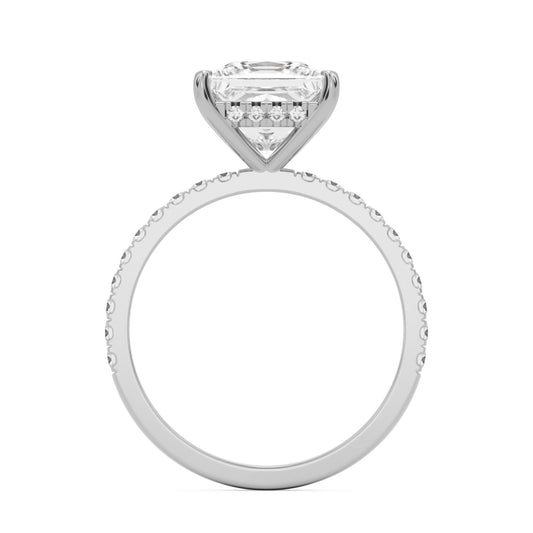
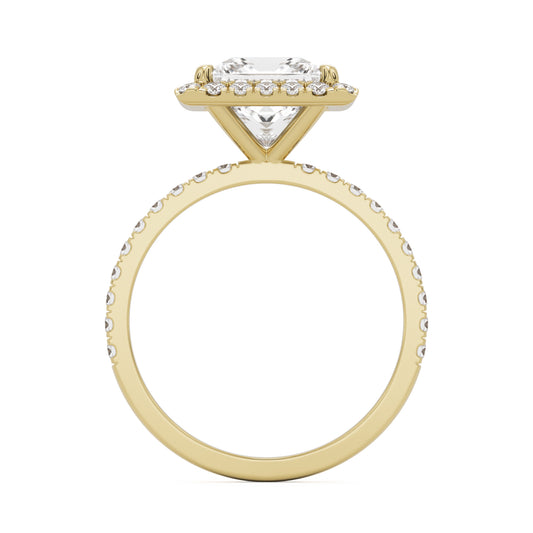
Pavé settings add smaller diamonds along the band, extending additional sparkle beyond the center stone.
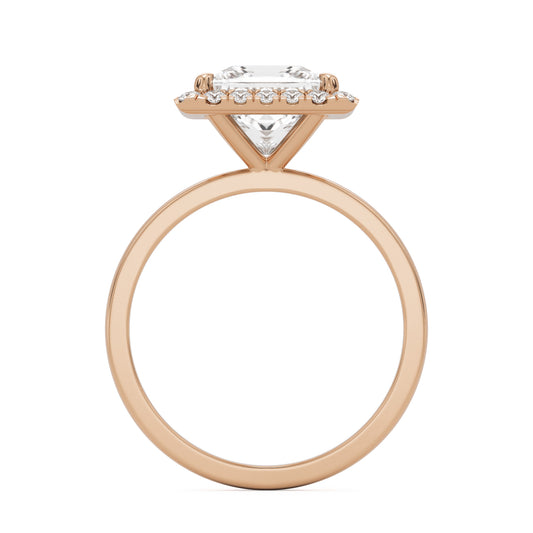
Hidden halo settings place accent diamonds beneath the center stone, adding detail to the profile without surrounding its square face-up outline.
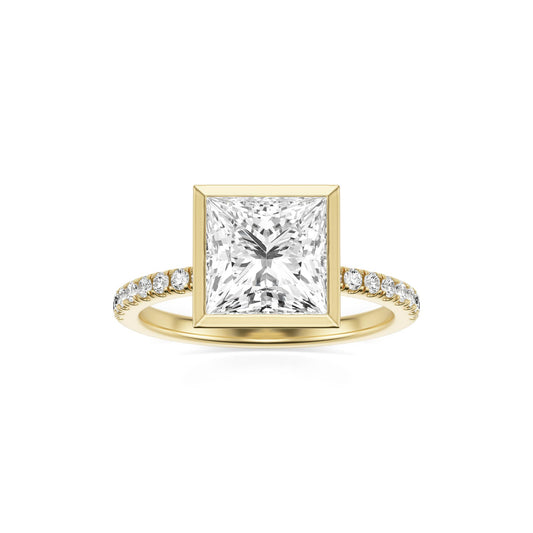
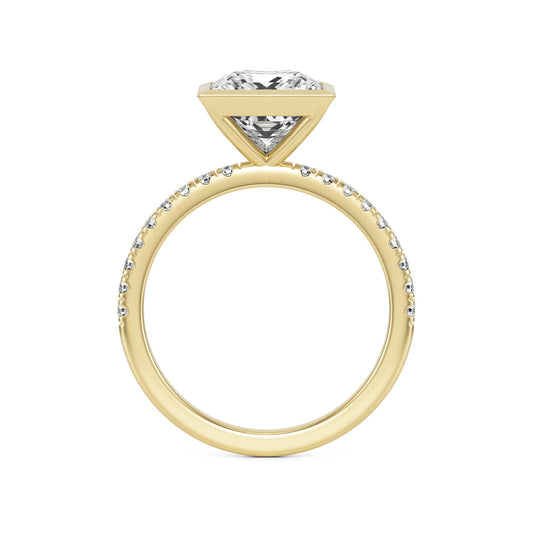
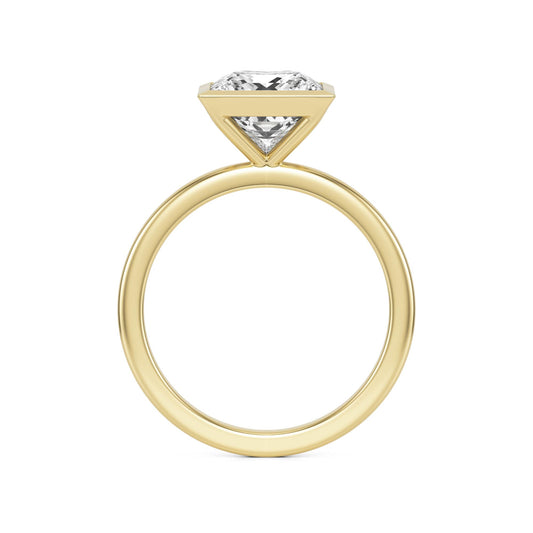
Bezel settings surround the princess diamond with precious metal, creating a highly geometric appearance while protecting its edges and corners.
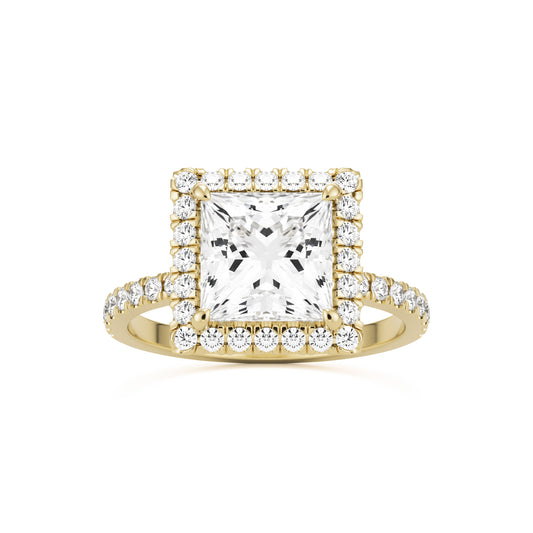
Halo settings surround the square center stone with smaller diamonds, increasing brilliance and overall visual presence.
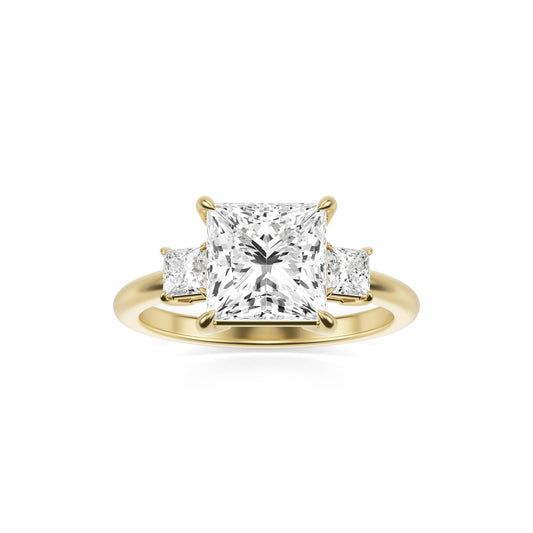
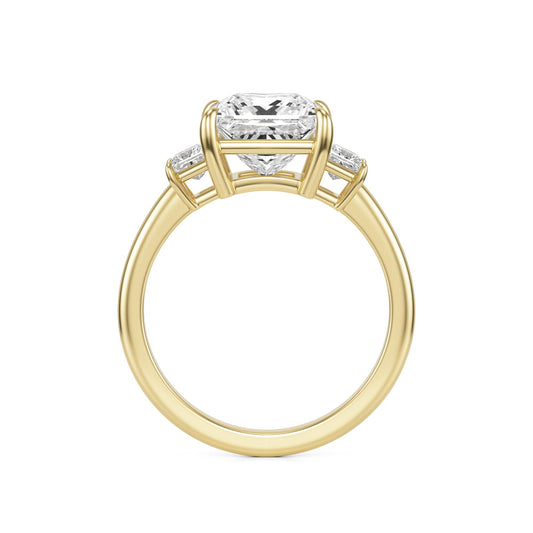
Three-stone settings combine a princess center diamond with complementary side stones to create additional width across the finger.
Princess Cut Lab Diamonds by Carat Weight
Carat measures a diamond's weight rather than its exact face-up dimensions. Two princess diamonds of the same carat weight can therefore appear different in size depending on their width, length and depth.
Shop Gema&Co lab grown diamond engagement rings by center-stone carat weight:
When comparing princess cut diamonds, actual millimeter dimensions provide useful context alongside carat weight because a portion of the diamond's weight is carried in its depth.
Choosing Princess Cut Diamond Proportions
Princess cut diamonds are generally selected for their square appearance, so the relationship between length and width is an important visual characteristic.
A stone with very similar length and width measurements will appear distinctly square. As the difference between those measurements increases, the diamond begins to appear more rectangular.
Symmetry also matters. Straight, balanced sides and evenly aligned corners contribute to the clean geometric appearance that defines the princess cut.
Princess Cut Facets and Chevron Patterns
Princess diamonds can have different pavilion facet arrangements, often described in terms of the number and configuration of chevrons.
These variations influence the size and pattern of reflections visible through the diamond. Some facet arrangements can create broader flashes, while others produce a greater number of smaller flashes.
Chevron configuration is not a simple measure of whether one princess diamond is “better” than another. It is one of several characteristics—including proportions, symmetry and overall light performance—that contribute to how the individual stone looks.
Protecting the Corners of a Princess Cut Diamond
The four pointed corners are among the princess cut's most recognizable features, but they also require appropriate protection.
A properly designed setting should secure the corners to reduce their exposure to direct impacts. Prongs can be positioned specifically around the corners, while a bezel can surround the perimeter of the stone.
Corner protection is particularly important because damage to a pointed corner can affect both the structural integrity and appearance of the diamond.
Princess Cut vs. Radiant Cut Lab Diamonds
Princess and radiant diamonds both combine angular outlines with brilliant-style faceting, but their shapes are noticeably different.
A princess cut generally has a square outline with four pointed corners. A Radiant Cut Lab Diamond Engagement Ring has cropped corners, giving it an eight-sided perimeter, and can range from square to distinctly elongated.
Princess is therefore a strong choice for someone who wants a crisp, uninterrupted square silhouette, while radiant offers similar brilliant-style sparkle with cropped corners and a wider range of rectangular proportions.
Princess Cut vs. Cushion Cut Lab Diamonds
Princess and cushion diamonds can both have approximately square proportions, but their outlines create very different appearances.
A princess diamond has straight sides and sharp corners, creating a crisp geometric shape. A Cushion Cut Lab Diamond Engagement Ring has rounded corners and generally softer sides.
Cushions can also be significantly elongated, while princess cuts are most strongly associated with square proportions.
The choice largely comes down to the desired outline: princess for sharp geometry; cushion for softer corners and curves.
Princess Lab Diamond Quality and IGI Grading
Lab grown diamonds are real diamonds with the same fundamental chemical composition, crystal structure and physical properties as mined diamonds. Their primary difference is origin: lab grown diamonds are created in controlled laboratory environments rather than mined from the earth.
Diamond quality is evaluated using characteristics including cut, color, clarity and carat weight. For princess diamonds, symmetry, dimensions, proportions, corner condition and overall light performance should also be considered.
At Gema&Co, lab grown center diamonds 1.00 carat and larger are IGI graded. Diamonds 0.99 carat and below are not individually graded.
Princess Lab Diamond vs. Princess Moissanite
Princess lab diamonds and princess moissanite can share the same square silhouette and brilliant-style appearance, but they are different gemstones.
A lab grown diamond has the same fundamental chemical and physical properties as a mined diamond. Moissanite is silicon carbide and has different optical properties, including greater dispersion that can produce more noticeable flashes of spectral color.
Explore Gema&Co's Princess Cut Moissanite Engagement Rings to compare the two.
You can also browse the complete Lab Grown Diamond Engagement Rings collection to compare additional shapes, carat weights and setting styles.
Frequently Asked Questions
What is a princess cut lab grown diamond?
A princess cut lab grown diamond is a lab-created diamond typically cut into a square shape with straight sides, pointed corners and brilliant-style faceting.
Do princess cut diamonds sparkle?
Yes. Princess diamonds use brilliant-style faceting and can produce substantial sparkle and scintillation. Their light pattern differs from a round brilliant because of their square geometry and facet arrangement.
Are princess cut diamonds always square?
Princess cuts are most commonly square, although individual stones can vary slightly in their length-to-width proportions. Buyers seeking the classic princess appearance generally look for dimensions that create a visibly square outline.
What are chevrons in a princess cut diamond?
Chevrons are portions of the princess cut's pavilion facet pattern. Different configurations can change the size and number of reflections visible through the diamond, contributing to differences in its face-up appearance.
Are the corners of a princess diamond fragile?
The pointed corners require appropriate protection because they can be more vulnerable to direct impacts than rounded edges. A properly designed setting should protect all four corners with appropriately positioned prongs or a surrounding bezel.
Does a princess cut diamond look larger than a round diamond?
Perceived size depends on the individual diamonds being compared. Princess cuts extend into four corners and can provide a substantial square face-up footprint, but carat weight alone does not determine visible size. Actual millimeter dimensions are the better comparison.
What is the difference between princess and radiant cut diamonds?
Both use brilliant-style faceting, but a princess generally has four sharp corners and a square outline. Radiant diamonds have cropped corners and can be square or elongated.
What is the difference between princess and cushion cut diamonds?
Princess diamonds have straight sides and sharp corners. Cushion diamonds have rounded corners and a softer outline and can range from square to elongated proportions.
What setting is best for a princess lab diamond?
Princess diamonds work with many settings. A solitaire emphasizes the square center stone, while pavé, hidden halo, halo and three-stone designs add different levels of accent detail.
Are Gema&Co princess cut lab diamonds IGI graded?
Gema&Co lab grown center diamonds 1.00 carat and larger are IGI graded. Diamonds 0.99 carat and below are not individually graded.
What carat sizes are available?
Browse Gema&Co's 1 carat, 2 carat, 3 carat, 4 carat, and 5 carat & up lab diamond engagement ring collections.
Can I customize a princess cut lab diamond engagement ring?
Yes. Gema&Co princess cut lab diamond engagement rings are available with different center-stone sizes, precious metals and setting styles, with additional customization options available for specific design requirements.