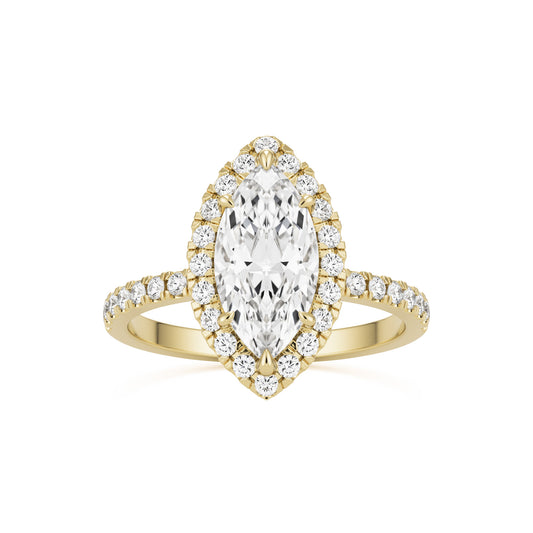
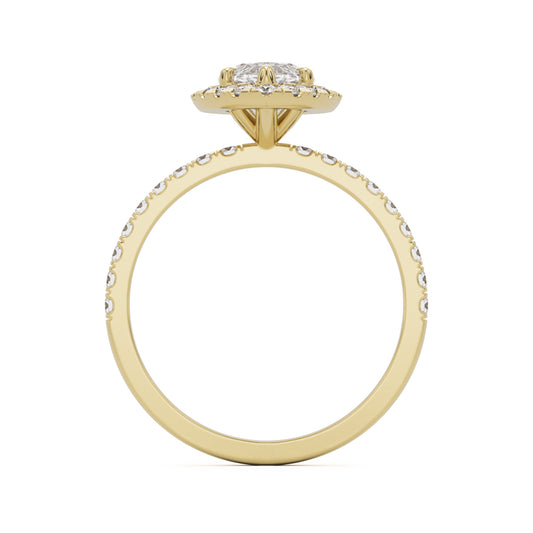
What Makes a Marquise Cut Diamond Different?
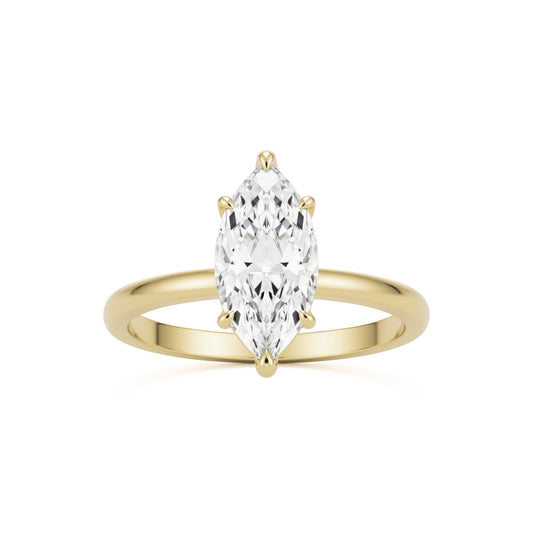
The marquise cut is immediately recognizable by its long, narrow profile and two pointed ends. Its brilliant-style facet pattern is designed to produce sparkle while the elongated outline distributes the diamond's weight across a relatively large face-up area.
This combination makes finger coverage one of the marquise cut's defining characteristics. Compared with more compact diamond shapes of similar carat weight, a well-proportioned marquise can appear visually larger when viewed from above.
Shape and symmetry are especially important. The two pointed ends should align with one another, and the curved sides should create a balanced outline without appearing uneven.
Marquise Lab Diamond Ring Styles
The dramatic outline of a marquise diamond works with both minimal and highly detailed engagement ring settings.
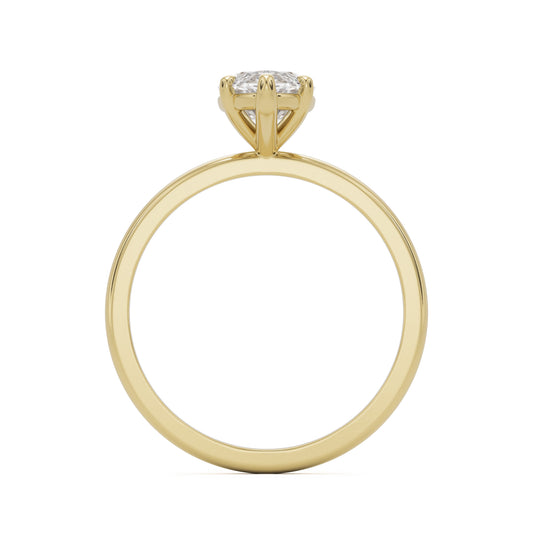
Solitaire settings keep attention on the center diamond and emphasize its elongated shape.
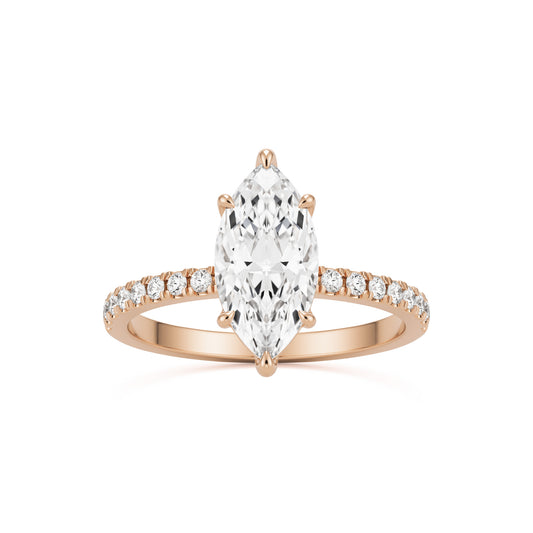
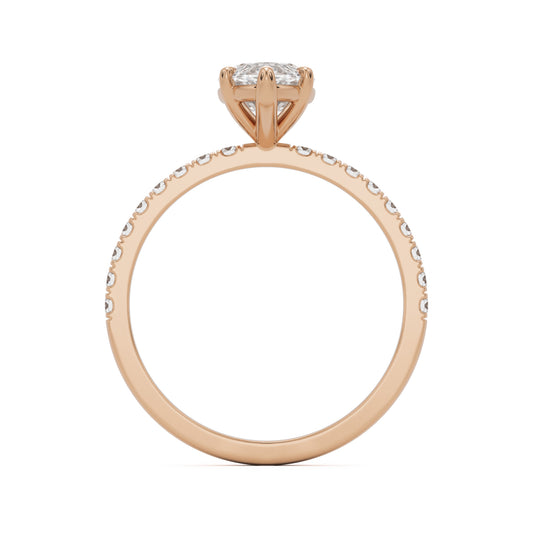
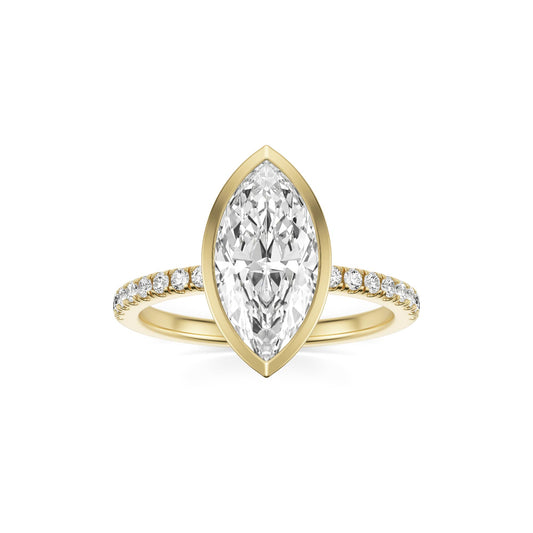
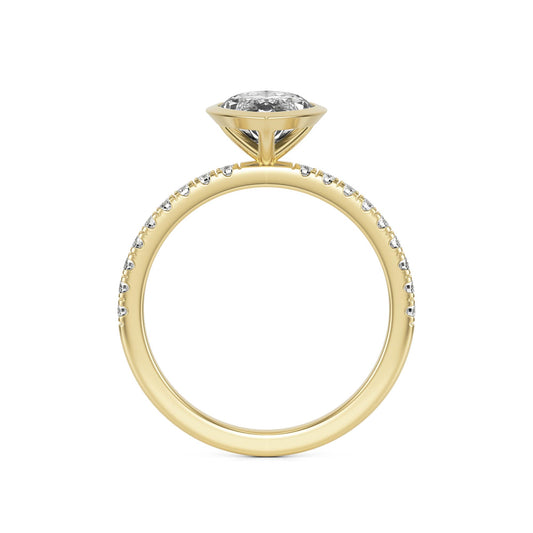
Pavé settings add smaller diamonds along the band, extending additional sparkle around the center stone.
Hidden halo settings place accent diamonds beneath the center stone while leaving the marquise outline visually prominent from above.
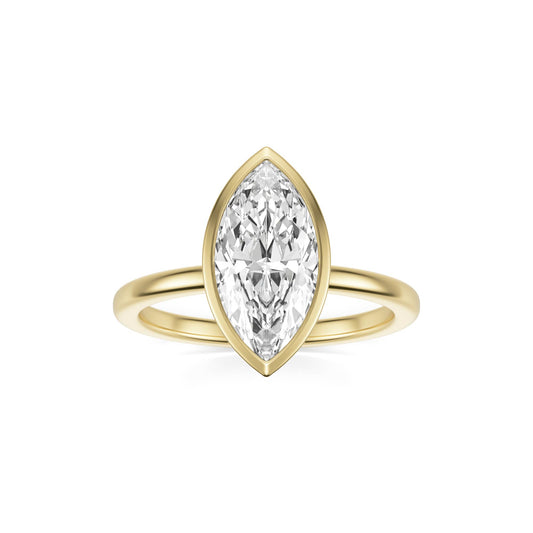
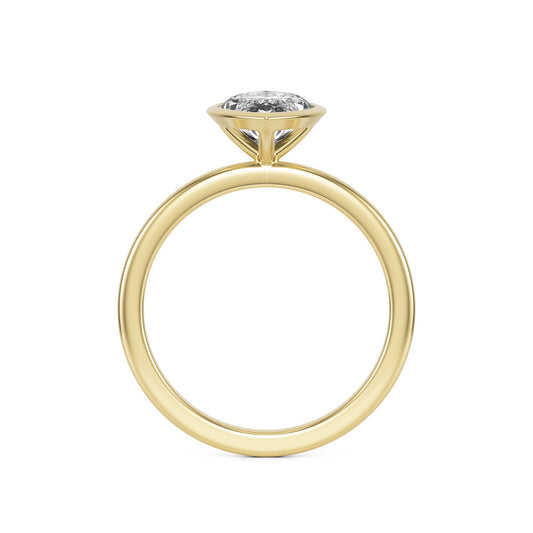
Bezel settings surround the perimeter of the diamond with precious metal and can provide additional protection around its pointed ends.
Halo settings follow the marquise outline with smaller diamonds, increasing brilliance and overall visual presence.
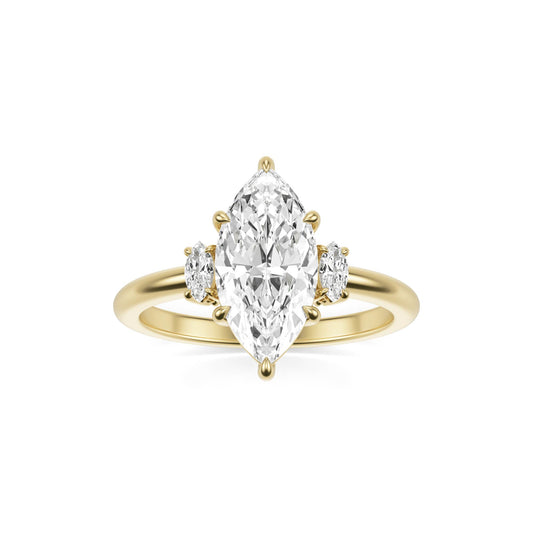
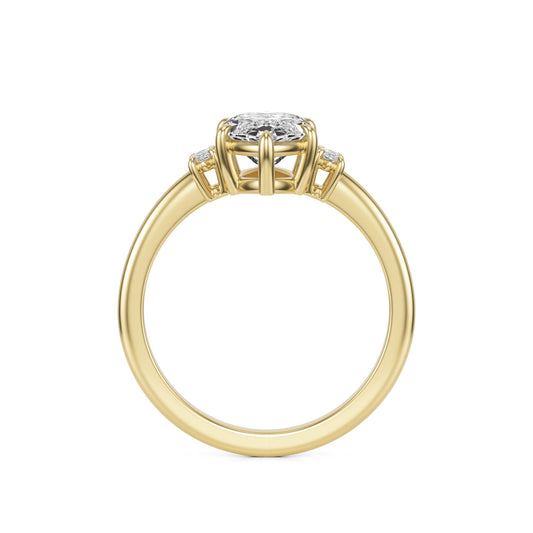
Three-stone settings combine a marquise center diamond with complementary side stones for additional width across the finger.
Marquise Lab Diamonds by Carat Weight
Carat measures diamond weight rather than exact visible dimensions. Because the marquise cut distributes its weight across an elongated outline, its face-up appearance can vary significantly between diamonds with the same carat weight.
Shop Gema&Co lab grown diamond engagement rings by center-stone carat weight:
When comparing marquise diamonds, consider actual millimeter dimensions and proportions alongside carat weight. Length and width provide a clearer indication of how much space the diamond will occupy when viewed from above.
Choosing Marquise Diamond Proportions
Length-to-width ratio has a significant effect on the appearance of a marquise diamond.
A lower ratio produces a wider, fuller marquise, while a higher ratio creates a longer and narrower silhouette. There is no single ideal ratio for every ring; the preferred proportion depends on how elongated you want the center stone to appear.
Symmetry is also particularly important because the marquise shape has two opposing points. The tips should align through the center of the stone, and the curved sides should appear balanced.
Why Do Marquise Diamonds Look Large for Their Carat Weight?
Marquise diamonds are known for their face-up spread.
Carat weight measures mass, including portions of the diamond that are not visible from above. The elongated dimensions of a marquise can distribute more of its visual footprint along the surface of the finger, creating substantial coverage.
This does not mean every marquise will appear equally large. Depth, dimensions and proportions still affect face-up size, which is why comparing millimeter measurements alongside carat weight is useful.
Protecting the Points of a Marquise Diamond
The two pointed ends are defining features of the marquise shape, but they also require appropriate protection from direct impacts.
A well-designed setting should protect both tips. Depending on the ring design, this can be accomplished with appropriately positioned prongs or with a bezel surrounding the stone.
Protecting the points is particularly important for a marquise because damage to either end can affect both the structural integrity and symmetry of the diamond.
Do Marquise Diamonds Have a Bow Tie?
Marquise diamonds can display a bow-tie effect, a darker area that may appear across the center of elongated brilliant-cut stones.
The visibility of a bow tie depends on the individual diamond's facet arrangement and proportions. Some marquise diamonds show only a subtle contrast, while others may have a noticeably dark area through the center.
A slight bow tie is not automatically a defect. The important consideration is whether it distracts from the diamond's overall brilliance and appearance.
Marquise vs. Oval Lab Diamond Engagement Rings
Marquise and oval diamonds are both elongated brilliant-style shapes, but their outlines create noticeably different appearances.
An Oval Lab Diamond Engagement Ring has rounded ends and a softer, symmetrical outline. A marquise diamond tapers to a point at both ends, producing a sharper and often more elongated silhouette.
Both shapes can provide substantial finger coverage. Marquise is particularly appealing for shoppers who want a more distinctive pointed shape and maximum visual length.
Marquise vs. Pear Lab Diamond Engagement Rings
Marquise and pear diamonds both incorporate pointed ends, but their symmetry is fundamentally different.
A marquise has a point at each end and is symmetrical along its length. A Pear Shaped Lab Diamond Engagement Ring has one rounded end and one pointed end, creating an asymmetrical teardrop silhouette.
Pear offers a directional shape, while marquise provides a balanced, double-pointed outline.
Marquise Lab Diamond Quality and IGI Grading
Lab grown diamonds are real diamonds with the same fundamental chemical composition, crystal structure and physical properties as mined diamonds. Their primary difference is origin: lab grown diamonds are created in controlled laboratory environments rather than mined from the earth.
Diamond quality is evaluated using characteristics including cut, color, clarity and carat weight. For marquise diamonds, symmetry, dimensions, length-to-width ratio and bow-tie visibility should also be considered.
At Gema&Co, lab grown center diamonds 1.00 carat and larger are IGI graded. Diamonds 0.99 carat and below are not individually graded.
Marquise Lab Diamond vs. Marquise Moissanite
Marquise lab diamonds and marquise moissanite can share the same elongated, double-pointed silhouette, but they are different gemstones.
A lab grown diamond has the same fundamental chemical and physical properties as a mined diamond. Moissanite is silicon carbide and has different optical properties, including greater dispersion that can produce more noticeable flashes of spectral color.
Explore Gema&Co's Marquise Moissanite Engagement Rings to compare the two.
You can also browse the complete Lab Grown Diamond Engagement Rings collection to compare additional shapes, carat weights and setting styles.
Frequently Asked Questions
What is a marquise lab grown diamond?
A marquise lab grown diamond is a lab-created diamond cut into an elongated shape with curved sides and a point at each end. Marquise diamonds generally use brilliant-style faceting to produce sparkle and scintillation.
Do marquise diamonds look larger for their carat weight?
They can. The elongated shape can provide substantial face-up coverage relative to more compact diamond shapes. Actual apparent size depends on the individual diamond's dimensions, depth and proportions.
What is the best length-to-width ratio for a marquise diamond?
There is no single best ratio. Lower ratios create wider marquise shapes, while higher ratios produce longer and narrower stones. The preferred ratio depends on the silhouette and finger coverage you want.
Do marquise diamonds have a bow tie?
They can. A bow tie is a darker area that may appear across the center of an elongated brilliant-cut diamond. Its visibility varies between individual stones and can range from subtle to pronounced.
Are the pointed ends of a marquise diamond fragile?
The points require appropriate protection because they can be more vulnerable to direct impacts than rounded edges. A properly designed setting should protect both ends with appropriately positioned prongs or a bezel.
Do marquise diamonds make fingers look longer?
Their elongated shape creates a strong vertical line along the finger, which can visually emphasize length. The effect varies depending on the diamond's proportions, carat size and ring design.
What setting is best for a marquise lab diamond?
A solitaire emphasizes the elongated center stone, while pavé, hidden halo, halo and three-stone settings add different levels of accent detail. Regardless of style, protecting both pointed ends is important.
Are Gema&Co marquise lab diamonds IGI graded?
Gema&Co lab grown center diamonds 1.00 carat and larger are IGI graded. Diamonds 0.99 carat and below are not individually graded.
What carat sizes are available?
Browse Gema&Co's 1 carat, 2 carat, 3 carat, 4 carat, and 5 carat & up lab diamond engagement ring collections.
Can I customize a marquise lab diamond engagement ring?
Yes. Gema&Co marquise lab diamond engagement rings are available with different center-stone sizes, precious metals and setting styles, with additional customization options available for specific design requirements.